Pearls present a unique paradox in material processing: they are both resilient and fragile. Composed primarily of aragonite platelets bound by organic proteins, their layered structure—often described within nacre—gives them luster and strength, yet also makes them susceptible to cracking under poorly controlled stress. Drilling a clean, centered hole through such a material demands more than steady hands; it requires an understanding of micro-scale mechanics and material behavior.
At the core of precision pearl hole drilling machine lies the management of force and heat. Unlike metals or gemstones, pearls cannot dissipate heat efficiently. Excessive friction at the drill–surface interface may lead to localized thermal expansion, causing microfractures or discoloration. To mitigate this, high-speed micromotors are paired with extremely fine drill bits—often made from tungsten carbide or diamond-coated materials—to ensure sharp cutting edges and minimal resistance.
The geometry of the drill bit is equally critical. A narrow point angle reduces the initial contact area, allowing gradual penetration rather than abrupt force application. This approach minimizes stress concentration, a concept closely related to fracture mechanics, where controlling how cracks initiate and spread determines whether the pearl remains intact. Engineers fine-tune these geometries to match the hardness gradient within different pearl types, from freshwater to South Sea varieties.
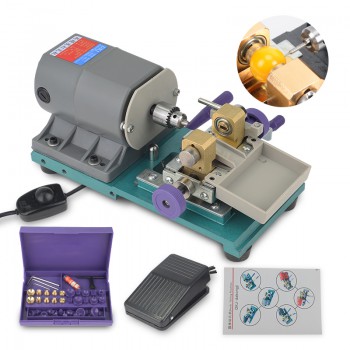
Another essential element is rotational stability. Even slight deviations in axis alignment can result in eccentric drilling, producing off-center holes or internal chipping. Advanced systems incorporate vibration damping and real-time feedback loops that stabilize rotation at the micron level. These controls are informed by principles of rotational dynamics, ensuring that angular velocity remains constant despite variations in load as the drill advances.
Cooling and lubrication strategies further enhance precision. Instead of traditional liquid coolants, which may damage organic components, controlled air streams or micro-mist systems are used to reduce heat buildup while clearing debris. This maintains visibility and prevents particle accumulation that could otherwise increase friction.
Automation has also begun to reshape pearl drilling. Computer-guided positioning systems can detect the geometric center of each pearl using optical sensors, adjusting the drilling path accordingly. This reduces reliance on manual alignment and improves consistency across large batches, particularly in high-end jewelry production where symmetry is paramount.
Ultimately, precision pearl drilling is not merely a mechanical operation but a delicate negotiation between tool and material. By integrating insights from material science, physics, and engineering design, modern techniques achieve results that were once considered unattainable. The process transforms a naturally formed object into a functional component of jewelry without compromising its intrinsic beauty—a quiet testament to the power of applied science.
